
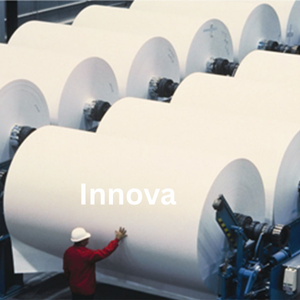
Innovacorp India manufactures sizing agents, retention aids, strength resins and process chemicals for paper and board mills in the United States. The range is built for the reality of US papermaking: a mix of virgin and recycled fiber, high machine speeds, and a wet-end that has to stay stable while furnish quality shifts. Containerboard remains the largest segment by capacity, and recycled fiber is a major feed source for many mills [citation:3][citation:15]. The chemistry has to work on both.
A paper machine is a continuous chemical reactor. The furnish arriving at the headbox carries fibers, fillers, fines, dissolved organics and ions, all interacting in water that is recirculated through the short loop. The chemicals added at the wet end — retention aids, sizing agents, strength resins, coagulants — are not independent additives. They compete for the same surfaces and the same charge sites. A retention aid that works on virgin kraft furnish may fail on a recycled furnish loaded with anionic carryover from inks and coatings. An AKD size that gives good water resistance on one machine may cause deposition and foam on another if the charge balance is wrong [citation:8]. The chemical programme is selected around the furnish and the machine, not from a standard list.
US paper mills vary widely by grade. Containerboard mills run high recycled fiber content and need strength and drainage. Tissue mills need softness and absorbency with controlled strength. Printing and writing mills, though a shrinking segment, need sizing and surface quality [citation:3]. The wet-end addition points follow the machine layout:
The first question is not which product, but what the furnish is carrying. Virgin kraft furnish has a relatively predictable charge. Recycled furnish is variable: old corrugated containers carry starch and adhesives, coated broke carries polyacrylate dispersants, and newsprint carries ink residues. These anionic substances form complexes with cationic retention aids and reduce their effectiveness [citation:8]. A charge demand measurement on the thick stock is the starting point. If the demand is high, a coagulant or a high-charge cationic polymer is needed before the retention aid. If the demand is low, a high-molecular-weight retention aid alone may be enough. The same logic applies to sizing: AKD needs to stay on the fiber long enough to cure, and poor retention means poor sizing [citation:13].
Appearance, pH, active content, viscosity and shelf life are listed in the product TDS. TDS is available on request for each grade.
Dosage depends on the furnish, the machine and the target sheet property. Retention aid dosage is often expressed in kg per ton of paper or as ppm in the thin stock. Sizing dosage depends on the target Cobb or HST value and the filler level. Strength resin dosage depends on the required strength gain. Feeding points and dilution vary by product. Final dosage and feeding are confirmed after a machine trial; TDS and trial guidance are available on request.
Standard industrial packing; pack sizes on request.
The most common mistake is treating retention as a single-product problem. On a recycled fiber machine, adding more retention aid without addressing the anionic carryover usually makes the problem worse, not better. The charge has to be managed first. The second mistake is ignoring water hardness. Calcium and magnesium ions react with sizing agents and anionic components, forming deposits on the machine and reducing sizing efficiency [citation:4]. The third is changing multiple chemicals at once. When a machine trial changes the retention aid, the sizing agent and the defoamer together, there is no way to know which change helped or hurt. One variable at a time, with a measurable target, is the only reliable approach.
We work with mill chemists and machine crews to review furnish data, select the grade and set feeding points. TDS and dosing guidance are shared on request. Final specification and dosage are confirmed after a machine trial on your furnish.
AKD sizing is typically dosed into the thin stock or approach flow system, upstream of the headbox, with a retention aid to keep the size on the fiber. Dosage depends on furnish type, filler level and target Cobb or HST value. Final dosage is confirmed after a machine trial; TDS and dosing guidance are available on request.
Recycled furnish carries dissolved and colloidal anionic substances from inks, coatings and fillers. These interfere with cationic retention aids and reduce first-pass retention. Charge demand measurement and a suitable coagulant or charge-control additive are usually needed before the retention aid can work effectively.
Calcium and magnesium ions can react with sizing agents and anionic components to form deposits and reduce sizing efficiency. High hardness also changes the charge balance in the wet end. Water hardness should be reviewed as part of grade selection; the final recommendation is confirmed after a lab trial.
Shelf life and storage conditions are listed in the product TDS. Most grades should be stored in a cool, dry place in the original packing, away from direct sunlight and freezing. TDS is available on request.
Call +91-9312871070 to discuss grade selection and wet-end support for your mill.
© 2026 Innovacorp India Pvt Ltd. All Rights Reserved. Managed & Developed by Innova Corporate India
 Chat with Us