
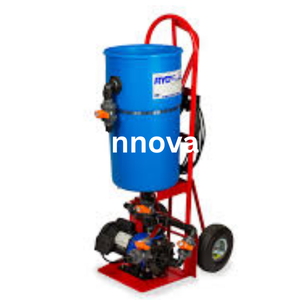
Innovacorp manufactures Descaling Chemicals and CIP circulation systems for industrial plants in the United States. This page covers the chemistry and the cleaning method: sulfamic acid descalers, inhibited hydrochloric acid descalers, citric and EDTA based systems, and the circulation setup for process lines that need regular cleaning. It is not a sugar-specific page. The focus here is on removing scale without damaging the metal underneath. For the root descaling range, see our descaling chemicals and CIP systems for industrial equipment.
Scale is an insulator. A millimetre of calcium carbonate on a boiler tube cuts heat transfer enough to raise fuel consumption. On a chiller condenser, it raises condensing pressure and compressor load. On a heat exchanger, it slows flow and pushes pump duty up. Anyone who has watched a boiler lose steam output over a season knows that scale rarely announces itself. It just quietly eats efficiency until maintenance becomes urgent.
The chemistry of scale removal is straightforward in principle: acid dissolves the scale. The complication is that the same acid that dissolves calcium carbonate will also attack mild steel, copper alloys and stainless steel if it is not properly inhibited. This is why descaling is a metallurgy decision as much as a chemistry decision. The right descaler for a stainless steel plate heat exchanger is not the same as the right descaler for a mild steel boiler tube.
The descaler selection depends on two factors: the scale composition and the metals in the equipment.
Sulfamic acid based descalers: safer handling than hydrochloric acid, suitable for a wide range of metals including copper and mild steel. Sulfamic acid is often chosen for chiller and heat exchanger cleaning where the metallurgy includes copper alloys.
Inhibited hydrochloric acid descalers: fast dissolution of hard carbonate scales. The inhibitor package protects the base metal during the cleaning cycle. HCl is effective on calcium carbonate scale but is not suitable for stainless steel in all conditions because of chloride attack risk. It is commonly used for boiler water-side cleaning where the metallurgy is mild steel.
Citric acid and EDTA based descalers: for sensitive metallurgy and passivation-type cleaning. These are chelating agents rather than strong acids. They dissolve scale by binding the metal ions rather than by acid attack, which makes them gentler on the base metal. They are often used where HCl or sulfamic acid would be too aggressive.
CIP circulation systems: for process lines that require regular cleaning cycles, the chemical is only half the solution. The circulation setup, the flow rate, the temperature and the contact time all matter. A CIP system is designed around the specific line and the cleaning protocol.
Descaling is a maintenance activity, not a production process. It happens across multiple industries wherever heat transfer surfaces accumulate scale.
Boilers: water-side scale removal from tubes and drums. The scale is usually calcium carbonate or calcium sulphate. Boiler descaling is typically done during a planned shutdown, with the acid circulated through the water side and then drained, rinsed and passivated.
Heat exchangers and chillers: shell-and-tube and plate-type cleaning. Chiller condensers are a common descaling application because scale on the condenser tubes raises head pressure and reduces cooling capacity. HVAC and process cooling circuits in US commercial and industrial buildings rely on periodic descaling to maintain efficiency.
Evaporators and crystallizers: in process industries, including sugar mills, evaporator tubes accumulate scale that reduces steam economy. Descaling is done between campaigns or when the evaporator performance drops. For the sugar-specific antiscalant that prevents scale formation in the first place, see our anti-scalants for pan evaporators.
Process pipelines and vessels: dairy, food, pharma and chemical process lines use CIP circulation to remove scale and product residue between production runs. The cleaning protocol is often product-specific and validated.
A descaler is only one part of the cleaning procedure. The method matters as much as the chemistry.
For boiler cleaning, a typical procedure includes a pre-rinse to remove loose debris, the acid circulation stage at the recommended concentration and temperature, a rinse to remove spent acid, and a passivation step to protect the bare metal surface that has been exposed by scale removal. The passivation step is important because the freshly cleaned metal is more susceptible to corrosion than the scaled surface was.
Temperature and contact time are control variables. Higher temperature speeds up the reaction but also increases the corrosion risk if the inhibitor is not matched to the conditions. Contact time depends on scale thickness. A thin scale may clean in two hours; a thick scale may need a second circulation.
Inhibitor concentration must be confirmed before circulation begins. A coupon test — placing a small piece of the same metal as the equipment into a sample of the prepared acid — is a practical way to confirm that the inhibitor is working. If the coupon shows reaction (bubbles or discoloration), more inhibitor is needed before the acid is circulated through the equipment.
Indicative values from our descaling range. Final specification is confirmed against your deposit analysis and equipment metallurgy. TDS is shared before order.
| Parameter | Typical Value |
|---|---|
| Appearance | Clear to pale-coloured liquid (grade dependent) |
| Active Acid Content | Grade dependent; confirmed on TDS |
| pH (concentrate) | Acidic; grade dependent |
| Specific Gravity | 1.05 – 1.20 |
| Inhibitor Package | Designed for MS, SS, copper and brass |
| Shelf Life | 12 months in unopened original packing |
TDS on request. Metallurgy suitability is confirmed after deposit analysis and coupon test.
Dosage and contact time depend on scale type, thickness and system metallurgy. Typical starting ranges:
These are starting points. Final dose and contact time are set after a deposit analysis and a coupon test.
Standard packing is 35 kg HDPE carboys, 200 kg HDPE drums and 1000 kg IBC tanks. Store in a cool, dry area away from direct sunlight and incompatible chemicals. Keep containers closed until use. Refer to the product SDS for handling and personal protective equipment requirements.
Descaling is a chemistry decision plus a metallurgy decision. The right descaler for a stainless steel plate heat exchanger is not the right descaler for a mild steel boiler. We prefer to review your deposit analysis, equipment metallurgy and cleaning procedure before recommending a grade and starting dose. Share your details with our technical team. Call +91-9312871070.
Q. What types of descaling chemicals does Innovacorp supply for US plants?
We supply sulfamic acid based descalers, inhibited hydrochloric acid descalers, and citric acid or EDTA
based descalers. Each grade is selected for the scale type and the metallurgy of the equipment being
cleaned. CIP circulation systems are also available for process lines that require regular cleaning
cycles.
Q. How is the right descaler selected for a boiler or heat exchanger?
Selection depends on two factors: the scale composition and the metals in the equipment. Carbonate scale
responds to inhibited HCl, while sulfate or silica scale may need a different acid system. Copper and brass
require an inhibitor package designed for non-ferrous metals. A deposit analysis and a coupon test confirm
the selection before cleaning.
Q. What is the typical contact time for descaling a boiler?
Contact time depends on scale thickness and type. Typical circulation cleaning runs for 2 to 6 hours.
Thicker scales may need a second circulation. The cleaning procedure usually includes a pre-rinse, the acid
circulation stage, a rinse, and a passivation step to protect the bare metal surface after scale removal.
Q. What safety precautions are needed during descaling?
Acid descalers require appropriate personal protective equipment, including acid-resistant gloves, eye
protection and face shield. Ventilation is important because acid circulation can release fumes. The
inhibitor package must be confirmed before circulation begins, and the system should be monitored for acid
strength and temperature during the cleaning cycle.
Call +91-9312871070 to discuss your deposit analysis and request TDS for the descaler grade that fits your equipment metallurgy.
© 2026 Innovacorp India Pvt Ltd. All Rights Reserved. Managed & Developed by Innova Corporate India
 Chat with Us