
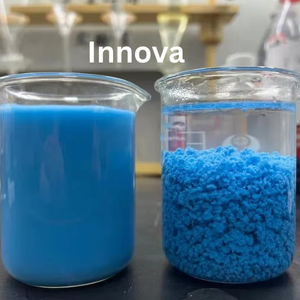
Innovacorp manufactures Decolourizing Agents for wastewater treatment in the United States. This page is about the cationic polymer chemistry used to remove colour from textile effluent, dyeing wastewater and industrial process water. It is not a sugar refinery page. The focus here is on the polymer, the dye chemistry it targets, and the conditions that determine whether the treatment works. For the sugar-side decolourization application, see our colour reducing agents for sugar processing. For the root wastewater range, see our decolourizing agent for industrial effluent.
Colour in textile and dyeing wastewater comes from dye molecules that are designed to resist degradation. They are formulated to stay on fabric through washing, light exposure and heat. The same properties that make them useful as dyes make them difficult to remove in a wastewater treatment plant.
The treatment challenge depends on the dye class. Acid dyes are relatively easy to remove by chemical treatment. Basic and direct dyes are moderate. Reactive dyes are the most difficult, often requiring higher coagulant doses and longer reaction times. A plant that processes multiple dye classes cannot use one treatment recipe for all of them. The decolourizing agent dose and the coagulant dose have to be adjusted for the dye stream being treated.
This is why jar testing on the actual wastewater is the starting point for any decolourization programme. A dose that works in one plant may not work in another because the dye mix is different.
Most dye molecules used in textile processing carry a negative charge in water. The decolourizing agent is a cationic polymer, meaning it carries a positive charge. When the polymer is dosed into the wastewater, the opposite charges attract. The polymer binds with the dye molecule and neutralises its charge.
Once the charge is neutralised, the dye-polymer complex becomes insoluble. It forms a floc that can be settled or filtered out. This is the same basic mechanism used in sugar juice clarification, where cationic polymers bind anionic colour bodies. The difference is the target: textile dyes are synthetic and designed for durability, while sugar colour bodies are natural plant compounds. The polymer chemistry is selected for the target, but the charge-based binding principle is the same.
Many decolourizing agents are based on dicyandiamide-formaldehyde resin chemistry or quaternary ammonium polymers. These chemistries are effective on anionic dyes and are used across textile effluent, dyeing wastewater, paper making wastewater and chemical wastewater.
Decolourizing agents are often used with a coagulant like polyaluminium chloride (PAC). The sequence matters. PAC is dosed first to destabilise the colloidal particles and begin floc formation. The decolourizing agent is dosed after, to bind the dye molecules specifically. An anionic polyelectrolyte may be added last to build larger flocs for faster settling.
The pH is a critical control point. Many decolourizing polymers work best in the pH range of 7 to 10. At lower or higher pH, the polymer charge or the dye chemistry can change, reducing effectiveness. The wastewater pH should be checked and adjusted before dosing if it falls outside this range.
For US textile plants, the treatment train has to meet effluent limits. The federal guidelines for textile mills (40 CFR Part 410) set limits for COD, TSS, pH and other parameters. pH must be within 6.0 to 9.0 at all times. The decolourization step is part of the overall treatment train, not a standalone solution. It reduces colour and contributes to COD reduction, but the biological treatment and filtration steps are still needed for the full effluent compliance.
The largest application is textile and dyeing wastewater, where colour is the most visible pollutant and the hardest to remove with conventional treatment. US textile operations include dyeing, printing, finishing and carpet manufacturing. The wastewater from these operations varies widely in colour load and dye chemistry.
Textile dyeing and finishing: the primary application. Colour removal is required for discharge compliance and for water reuse. Decolourizing agents are used in the treatment train alongside coagulation, biological treatment and filtration.
Dye manufacturing and printing: wastewater from dye synthesis and printing operations has high colour load and high COD. The decolourizing agent helps reduce both colour and organic load before biological treatment.
Paper and pulp: some paper making wastewater carries colour from lignin and dyes. The cationic polymer can help remove colour where the colour bodies are anionic.
Chemical and industrial wastewater: any industrial wastewater with anionic colour bodies can potentially be treated with a cationic decolourizing agent. The suitability depends on the specific chemistry of the colour bodies.
Indicative values from our decolourizing agent range. Final specification is confirmed against your wastewater analysis and treatment process. TDS is shared before order.
| Parameter | Typical Value |
|---|---|
| Appearance | Transparent to slightly hazy liquid |
| Type | Cationic polymer (dicyandiamide or quaternary ammonium) |
| Solid Content | 40% – 50% |
| pH (30% solution) | 3.0 – 5.0 |
| Specific Gravity | 1.15 – 1.30 (25°C) |
| Shelf Life | 12 months in unopened original packing |
TDS on request. Values vary by grade and application.
Dosage depends on the dye concentration, the dye class, the wastewater pH and the existing treatment process. Typical starting points are 50 to 300 ppm, confirmed by jar testing on the actual wastewater.
The jar test is the practical way to set the dose. It establishes the colour reduction achieved at different doses, the floc formation and settling behaviour, and the compatibility with the coagulant and flocculant already in use. A dose that looks good in a jar test may behave differently in the plant because of mixing, retention time and temperature, but the jar test is the starting point.
For plants with variable dye streams, the dose may need to be adjusted when the dye recipe changes. A treatment programme that is not reviewed against the current wastewater is a programme that will eventually fail.
Standard packing is 30 kg / 250 kg plastic drums and 1250 kg IBC tanks. Store at room temperature, within a range of 10 to 30°C. Keep containers closed until use. Refer to the product SDS for handling and personal protective equipment requirements.
Decolourization is wastewater-specific. A polymer that works on one dye stream may underperform on another because the dye chemistry is different. We prefer to review your wastewater analysis, dye types and current treatment process before recommending a grade and starting dose. Share your process details with our technical team. Call +91-9312871070.
Q. How do cationic decolourizing agents work on textile wastewater?
Cationic decolourizing agents carry a positive charge that binds with the negative charge on anionic dye
molecules. This charge neutralisation forms an insoluble floc that can be settled or filtered out of the
wastewater. The process is often used alongside coagulants like PAC to improve colour removal and reduce
COD.
Q. What pH range is required for effective decolourization?
Many decolourizing polymers work best in the pH range of 7 to 10. At lower or higher pH, the polymer charge
and the dye chemistry can change, reducing effectiveness. The wastewater pH should be checked and adjusted
before dosing if it falls outside this range.
Q. Which dye classes are hardest to decolourize?
Reactive dyes are generally more difficult to decolourize than acid or disperse dyes. Acid dyes respond
relatively easily to chemical treatment, while reactive dyes require higher coagulant doses and may need a
combination of treatments. Bench testing with the actual wastewater is the practical way to confirm which
treatment works for a specific dye stream.
Q. How is decolourizing agent dosage determined?
Dosage depends on the dye concentration, the type of dye, the wastewater pH and the existing treatment
process. Typical starting points are 50 to 300 ppm, confirmed by jar testing on the actual wastewater. The
jar test establishes the dose that achieves the required colour reduction without over-dosing.
Call +91-9312871070 to discuss your wastewater and request TDS for the decolourizing agent grade that fits your dye stream.
© 2026 Innovacorp India Pvt Ltd. All Rights Reserved. Managed & Developed by Innova Corporate India
 Chat with Us