
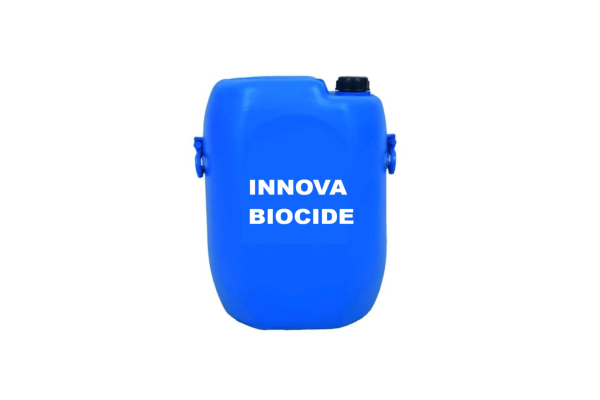
Innovacorp manufactures Industrial Biocides for water systems in the United States. This page is about microbial control in cooling towers, process water circuits and membrane systems. It is not a sugar mill sanitation product. The focus here is industrial water: biofilm on heat exchangers, algae in cooling basins, and bacterial growth that affects system performance. Both oxidizing and non-oxidizing chemistries are available, and the choice depends on where the biocide is dosed.
Most water treatment programmes measure bacteria in the bulk water. That measurement tells you about planktonic organisms, the ones floating freely. The bigger problem is usually sessile bacteria, the ones attached to surfaces in a biofilm. A cooling system can show acceptable planktonic counts while biofilm is actively growing on heat exchanger tubes.
Biofilm acts as an insulating layer. On a heat exchanger surface, it reduces heat transfer efficiency. The system then needs more energy to achieve the same cooling. Biofilm also creates a microenvironment under which corrosion can proceed, often called microbiologically influenced corrosion. US industrial facilities dealing with biofilm issues often see higher energy consumption, lower cooling capacity and increased maintenance before the problem becomes obvious in bulk water testing.
This is why biocide programmes for industrial water systems are designed around biofilm control, not just planktonic bacteria. The dosing strategy, the choice of chemistry and the frequency of application all matter.
Cooling water systems are the largest industrial biocide application in the US market, alongside process water and membrane systems. In an open recirculating cooling tower, water is exposed to air, sunlight and nutrients. Algae grow in the basin. Bacteria colonise the fill and the heat exchanger surfaces. The warm, aerated environment is ideal for microbial growth.
US cooling water programmes typically use a combination of oxidizing and non-oxidizing biocides. Oxidizing biocides like chlorine or bromine are effective for shock dosing and knocking down planktonic populations. Non-oxidizing biocides are used for sustained control, often alternating with oxidizers to prevent resistance and to penetrate biofilm that oxidizers alone cannot reach. The specific programme depends on system design, makeup water quality and the facility's operating schedule.
Process water systems have different requirements. In food and beverage plants, pulp and paper mills, and other industrial processes, the biocide must be compatible with the process itself. Some non-oxidizing chemistries are chosen specifically because they do not interfere with downstream operations.
Reverse osmosis membranes present a different challenge. Biofouling on RO membranes reduces flux and increases pressure drop. But not every biocide is compatible with every membrane. Polyamide membranes, the most common type in industrial RO, can be degraded by continuous exposure to strong oxidizers like free chlorine.
This is why RO pre-treatment often uses non-oxidizing biocides or controlled oxidizing programmes with dechlorination before the membrane. The dosing point matters: biocide is applied upstream to control bacterial growth in the feedwater, and any residual oxidant is removed before it reaches the membrane. US desalination and industrial RO facilities treat biofouling as a continuous control problem, not a one-time cleaning issue.
The choice between oxidizing and non-oxidizing biocides depends on the application and the constraints of the system.
For RO systems, the selection is narrower. Membrane compatibility is the first filter, and the programme is designed around it.
Indicative values from our industrial biocide range. Final specification is confirmed against your system and application. TDS is shared before order.
| Parameter | Typical Value |
|---|---|
| Appearance | Liquid; colour grade dependent |
| Type | Oxidizing / Non-oxidizing |
| Active Content | Grade dependent; confirmed on TDS |
| pH (1% solution) | Application dependent |
| Density | 1.00 – 1.30 g/cc |
| Shelf Life | 12 months in unopened original packing |
TDS on request. Values vary by chemistry and application.
Dosage depends on system volume, microbial load, retention time and the biocide chemistry. For cooling water systems, typical starting ranges are 25 to 100 ppm of product, confirmed after microbial testing. For RO pre-treatment, dosage is typically lower and set with membrane compatibility in mind.
Application points vary by system:
Standard packing is 35 kg / 50 kg HDPE carboys and 200 litre HDPE drums. Bulk supply is available on request. Store in a cool, dry area away from direct sunlight and incompatible chemicals. Keep containers closed until use. Refer to the product SDS for handling and personal protective equipment requirements.
Industrial water systems are not all the same. A cooling tower programme that works in one plant may not suit another because the makeup water, operating temperature and process leaks are different. RO systems add membrane compatibility as a constraint. We prefer to review your system type, water analysis and current treatment programme before recommending a biocide and dosing strategy. Share your system details with our technical team, and we will suggest a starting point for your own plant trial. Call +91-9312871070.
Q. What is the difference between oxidizing and non-oxidizing biocides for cooling towers?
Oxidizing biocides like chlorine or bromine react quickly and are used for shock dosing to knock down
planktonic bacteria. Non-oxidizing biocides work through specific mechanisms and are often used for
sustained control and biofilm penetration. Many US cooling water programmes alternate both types.
Q. How does biofilm affect cooling tower performance?
Biofilm on heat exchanger surfaces acts as an insulating layer, reducing heat transfer efficiency. It also
harbours bacteria that cause microbiologically influenced corrosion. US facilities with biofilm issues
often see higher energy consumption and lower cooling capacity before the problem is visible.
Q. Can the same biocide be used for cooling towers and RO systems?
Not always. RO membranes have compatibility limits, and some oxidizing biocides can damage polyamide
membranes. Non-oxidizing biocides are often preferred for RO pre-treatment. The choice depends on membrane
type and the overall treatment programme.
Q. How is biocide dosage determined for an industrial water system?
Dosage depends on system volume, microbial load, retention time and the biocide type. Typical starting
ranges for cooling water are 25 to 100 ppm of product, confirmed after microbial testing. RO dosing is
typically lower and set with membrane compatibility in mind.
Call +91-9312871070 to discuss your water system and request TDS for the biocide grade that fits your application.
© 2026 Innovacorp India Pvt Ltd. All Rights Reserved. Managed & Developed by Innova Corporate India
 Chat with Us