
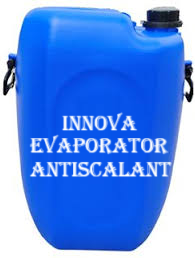
Innovacorp manufactures Evaporator Anti-Scalants for multiple-effect evaporator trains in US sugar mills. This page is about the evaporator station as a whole: the different effects, the changing scale profile from first to last effect, and the chemistry used to control deposition on tube surfaces. It is not a vacuum pan crystallizer page. The focus here is on the evaporator train where juice is concentrated from roughly 12–17% to 65–70% solids. For the pan-specific scaling problem, see our anti-scalants for pan evaporators.
An evaporator station is a series of effects, and each effect runs at a different temperature and brix. That difference changes the scale chemistry. Early effects are hotter and less concentrated. Later effects are cooler and more concentrated. The scale that forms in the first effect is not the same as the scale that forms in the last.
Research on sugar evaporator fouling shows this clearly. Calcium phosphate and calcium sulphate dominate in the early effects. Calcium oxalate, silica and silicates increase in proportion toward the later effects as temperature drops and sucrose concentration rises. Organic matter and corrosion products add to the complexity. A mill that treats the whole train as a single scaling problem misses the effect-by-effect variation that determines which tubes foul first and why.
This matters for anti-scalant selection. A product that performs well in the first effect may not be the best choice for the last effect, where calcium oxalate and silica composite scale is the dominant problem. The dose and the chemistry may need to be adjusted for the conditions in different parts of the train.
Calcium oxalate monohydrate and amorphous silica are the two components that make cane mill evaporator scale so difficult to manage. Both are sparingly soluble, and both become less soluble as sucrose concentration rises and temperature falls. In the later effects, they co-precipitate and form a hard composite deposit that adheres strongly to tube surfaces.
The composite nature of the deposit is the problem. Calcium oxalate alone can be attacked by certain cleaning chemicals. Silica alone has its own removal challenges. But when the two are deposited together, the composite is more resistant than either component separately. Mills often need staged cleaning with different chemicals to remove it, and even then the cleaning may not restore the tube surface completely. The practical consequence is shorter run times between boil-outs and higher cleaning costs.
This is why anti-scalant chemistry for cane mills has to address more than one scale type. A product that only targets calcium carbonate will underperform on a train where calcium oxalate and silica dominate the later effects.
The scale inhibitors used in sugar evaporators are typically polycarboxylic acids. They work through two mechanisms: threshold inhibition and crystal modification.
Threshold inhibition: the inhibitor keeps scale-forming salts soluble even when their concentration exceeds the normal saturation limit. It does this by interfering with the nucleation step, so crystals do not start to form as readily on the heated surface.
Crystal modification: when crystals do form, the inhibitor distorts their structure. The modified crystals are less likely to adhere firmly to the tube surface, and they are more easily carried away by the juice flow or removed during cleaning.
These inhibitors work in both cane and beet processing, but their effectiveness is not uniform. Cane juices carry a higher impurity load than beet juices, and that load can reduce inhibitor performance. This is one reason why cane mills often need higher doses or more frequent cleaning even with an anti-scalant programme in place. The product helps, but it does not eliminate the need for cleaning.
US sugar production is geographically concentrated, and the evaporator scaling problem varies by region and raw material.
Beet processing (Idaho, Minnesota, North Dakota, Michigan, and smaller operations in Colorado, Montana, Nebraska, Wyoming, California, Oregon, Washington): beet evaporators face their own scale profile. Calcium phosphate, calcium carbonate and calcium sulphate are common, with silica and oxalate in later effects. The northern states account for the majority of US beet processing capacity, with American Crystal Sugar, Michigan Sugar, Minn-Dak and Amalgamated Sugar operating multiple plants. Beet juice chemistry is different from cane, and the anti-scalant selection reflects that difference.
Cane processing (Florida and Louisiana): cane mills face the calcium oxalate and silica composite problem described above. Florida and Louisiana are the two cane-producing states, with Louisiana production growing in recent years. The warmer climate and the impurity profile of cane juice make the later-effect scaling problem more acute. Anti-scalant programmes in these mills typically include higher doses and closer monitoring of the last effects.
Both regions: the evaporator train is the bottleneck in many mills. If the evaporators cannot concentrate the juice to the target brix, the crystallization stage is limited regardless of how well the pans perform. Anti-scalant performance directly affects the mill's throughput.
Indicative values from our evaporator anti-scalant range. Final specification is confirmed against your juice analysis and evaporator conditions. TDS is shared before order.
| Parameter | Typical Value |
|---|---|
| Appearance | Clear to pale liquid |
| Type | Polycarboxylic acid based |
| pH (1% solution) | 2.0 – 4.0 |
| Active Content | 30% – 50% |
| Density | 1.10 – 1.25 g/cc |
| Shelf Life | 12 months in unopened original packing |
TDS on request. Values vary by grade and application point.
Dosage depends on juice quality, scale load and the effect where the product is dosed. Typical starting ranges are 5 to 30 ppm on juice, confirmed by plant trial. This is a starting range, not a fixed recommendation.
Application points vary by mill configuration:
The plant trial is the practical way to set the dose. It should check heat transfer coefficient recovery, boil-out frequency, and the scale composition in different effects. A dose that works in the first effect may need adjustment for the last effect.
Standard packing is 35 kg / 50 kg HDPE carboys and 200 litre HDPE drums. Bulk supply is available on request. Store in a cool, dry area away from direct sunlight and incompatible chemicals. Keep containers closed until use. Refer to the product SDS for handling and personal protective equipment requirements.
Evaporator anti-scalant selection depends on the juice chemistry, the evaporator configuration and the scale profile in different effects. A product that works in one mill may need adjustment in another because the impurity load is different. We prefer to review your juice analysis, evaporator train layout and current cleaning frequency before recommending a grade and starting dose. Share your details with our technical team. Call +91-9312871070.
Q. Why does scale composition change from the first to the last evaporator effect?
Temperature drops and sucrose concentration rises as juice moves through the evaporator train. Early
effects run hotter and have lower brix, so calcium phosphate and sulphate dominate. Later effects are
cooler and more concentrated, which favors calcium oxalate, silica and silicate deposition. This is why a
single anti-scalant dose may not perform equally across the whole train.
Q. What makes calcium oxalate scale difficult to remove in cane mills?
Calcium oxalate monohydrate is sparingly soluble, and its solubility drops further as sucrose concentration
rises and temperature falls. In later effects it co-precipitates with silica, forming a hard composite
deposit that is resistant to standard chemical cleaning. Mills often need staged cleaning with different
chemicals to remove it.
Q. How do polycarboxylic acid anti-scalants work in sugar evaporators?
Polycarboxylic acid inhibitors work through threshold inhibition and crystal modification. They keep
scale-forming salts soluble beyond their normal saturation point and distort crystal structure so deposits
do not adhere firmly to tube surfaces. They are effective in both cane and beet processing, though cane
juices with higher impurity loads can reduce their effectiveness.
Q. How is anti-scalant dosage determined for a US evaporator train?
Dosage depends on juice quality, scale load and the effect where the product is dosed. Typical starting
ranges are 5 to 30 ppm on juice, confirmed by plant trial. The trial should check heat transfer coefficient
recovery, boil-out frequency and scale composition in different effects.
Call +91-9312871070 to discuss your evaporator train and request TDS for the anti-scalant grade that fits your juice and scale profile.
© 2026 Innovacorp India Pvt Ltd. All Rights Reserved. Managed & Developed by Innova Corporate India
 Chat with Us