
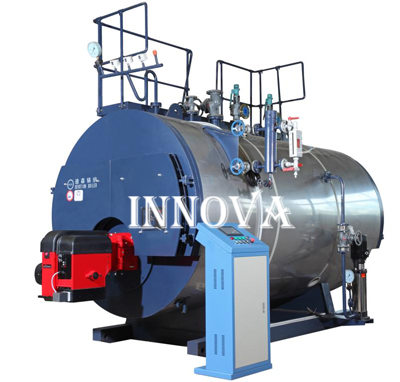
Innovacorp manufactures Boiler Water Treatment Chemicals for industrial plants in the United States. This page covers the chemistry that goes into the boiler and feedwater system: scale inhibitors, oxygen scavengers, alkalinity builders, sludge conditioners and condensate treatment. The focus is on what each chemical does, where it is dosed, and how the programme changes with boiler pressure and feedwater quality. For the broader chemical range, see our boiler chemicals for industrial systems.
Boiler water treatment is not a single product. It is a programme built around three problems that occur wherever water meets heat and steel [citation:7].
Scale: dissolved minerals in feedwater concentrate as water evaporates. Calcium and magnesium salts precipitate on heat transfer surfaces. A scale layer acts as an insulator. The metal underneath gets hotter than it should, and tube failure becomes a matter of time. Scale also raises fuel consumption because more heat input is needed to achieve the same steam output [citation:11].
Corrosion: dissolved oxygen causes pitting, a localised attack that can perforate a tube while the rest of the surface looks clean. Carbon dioxide in condensate forms carbonic acid, which attacks return lines. pH outside the recommended range accelerates both problems [citation:7].
Carryover: if boiler water chemistry is not controlled, foam and entrainment can carry dissolved solids into the steam. Those solids deposit on turbines, process equipment and steam traps. Carryover is often a symptom of high alkalinity or TDS, not a separate problem [citation:7].
ASME guidelines for boiler water quality become more restrictive as operating pressure rises [citation:1]. A low-pressure boiler can tolerate higher TDS and alkalinity. A high-pressure unit requires tighter control, often with demineralized feedwater and more precise chemical dosing.
This is why a treatment programme cannot be copied from one boiler to another without checking the operating pressure, feedwater analysis and steam demand pattern. The same scale inhibitor chemistry may be suitable across a pressure range, but the dosage and the supporting programme (oxygen scavenger, alkalinity control, blowdown schedule) will differ.
For US plants running high-pressure boilers, the feedwater is usually pretreated by softening, demineralization or reverse osmosis before it reaches the boiler. Pretreatment removes most of the scale- forming minerals, but it does not eliminate the need for internal treatment. Residual hardness, dissolved oxygen and corrosion products still require chemical control [citation:7].
Scale inhibitors work on crystal formation at the heated surface. They interfere with the growth of calcium carbonate, calcium sulphate or silica deposits. The mechanism varies by chemistry: some inhibitors adsorb onto crystal surfaces and prevent further growth, others distort the crystal structure so the deposit is softer and more easily removed.
Sludge conditioners work differently. They keep precipitated solids dispersed in the boiler water rather than allowing them to adhere to tube surfaces. The dispersed solids are then removed through blowdown. In practice, scale inhibitors and sludge conditioners are used together. The inhibitor handles the crystal formation at the surface; the conditioner handles the solids that are already in suspension.
For plants with variable feedwater quality, the balance between these two products may need adjustment seasonally or when the water source changes. This is one reason why a treatment programme is reviewed against water analysis rather than set once and left unchanged.
Mechanical deaeration removes most dissolved oxygen, but not all. The residual oxygen is addressed with a chemical oxygen scavenger. Sodium sulphite is common in lower and medium pressure boilers. Catalysed sulphite reacts faster. For higher pressure boilers where sulphite contributes to dissolved solids, other scavenger chemistries may be selected. The choice depends on pressure, feedwater quality and the plant's operating constraints.
Condensate treatment addresses a different problem. Carbon dioxide, formed when bicarbonate alkalinity breaks down under heat, dissolves in condensate to form carbonic acid. This attacks condensate return lines, which are often thin-walled and less tolerant of corrosion than boiler tubes. Neutralising amines are used to raise condensate pH and protect the return system. The amine selection depends on the system configuration and the materials of construction in the condensate network.
Sugar mills have a boiler water problem that general industrial plants do not face: sugar contamination. When juice heater, evaporator or pan tubes leak, juice enters the condensate system and finds its way back to the boiler feedwater [citation:4].
Once in the boiler, sucrose and reducing sugars break down under heat to form organic acids. The boiler water pH drops. More caustic is added to correct it. But adding caustic raises dissolved solids, which increases the risk of carryover. A leak that starts as a small tube failure can escalate into a steam purity problem that affects the entire plant [citation:4].
Sugar mills typically monitor condensate for carbohydrate contamination using colorimetric testing. Normal condensate pH is in the range of 8.0 to 9.5. A drop in pH or a positive sugar test indicates a leak that needs attention before the boiler chemistry is affected. The boiler treatment programme in a sugar mill therefore includes not just the standard scale and corrosion control, but also a monitoring routine for contamination [citation:4].
Indicative values from our boiler chemical range. Final specification is confirmed against your boiler pressure, feedwater analysis and treatment programme. TDS is shared before order.
| Product Type | Typical Form | Application |
|---|---|---|
| Scale Inhibitor | Liquid (polymer-based) | Feedwater or boiler, continuous |
| Oxygen Scavenger | Liquid (sulphite or alternative) | Feedwater, continuous |
| Alkalinity Builder | Liquid (alkaline) | Boiler water, continuous |
| Sludge Conditioner | Liquid (polymer) | Boiler water, continuous |
| Condensate Treatment | Liquid (amine blend) | Steam/condensate, continuous |
TDS on request. Dosage and specific grade depend on boiler pressure and water analysis.
Dosage for boiler chemicals is set by water analysis, not by a fixed formula. The starting point is the feedwater and boiler water specification for your operating pressure. ASME guidelines provide reference limits for TDS, alkalinity and silica at different pressure ranges [citation:1].
Typical control practice includes:
Blowdown is part of the control system. It removes dissolved solids that accumulate as steam is generated. The blowdown rate is set by the boiler water TDS limit for the operating pressure. Chemical treatment and blowdown work together; one cannot compensate for the other.
Standard packing is 35 kg / 50 kg HDPE carboys and 200 litre HDPE drums. Bulk supply is available on request. Store in a cool, dry area away from direct sunlight and incompatible chemicals. Keep containers closed until use. Refer to the product SDS for handling and personal protective equipment requirements.
Boiler water treatment is programme work, not product selection alone. The right combination of scale inhibitor, oxygen scavenger, alkalinity builder and condensate treatment depends on your boiler pressure, feedwater quality and operating pattern. For sugar mills, condensate monitoring for sugar contamination is part of the picture. We prefer to review your water analysis and current programme before recommending a starting point. Share your boiler details with our technical team. Call +91-9312871070.
Q. What are the main water-side problems in an industrial boiler?
The three main problems are scale deposition on heat transfer surfaces, corrosion of boiler metal and feed
lines, and carryover of boiler water into steam. Scale reduces heat transfer and can lead to tube
overheating. Corrosion includes oxygen pitting and carbonic acid attack in condensate lines. Carryover
affects steam purity and can deposit on turbines or process equipment.
Q. How does boiler pressure affect chemical treatment requirements?
Higher pressure boilers require tighter control on water quality. ASME guidelines for TDS, alkalinity and
silica become more restrictive as pressure increases. A low-pressure boiler may tolerate higher TDS, while a
high-pressure unit needs demineralized feedwater and more precise chemical dosing. The treatment programme
is selected for the operating pressure, not as a one-size-fits-all.
Q. Why is sugar contamination a special concern in sugar mill boilers?
Sugar entering boiler feedwater through leaking juice heater or evaporator tubes breaks down under heat to
form organic acids. This drives pH down and increases corrosion risk. More caustic is then needed to
correct pH, which raises dissolved solids and can cause carryover. Sugar mills typically monitor condensate
for carbohydrate contamination as part of the boiler water programme.
Q. What is the difference between scale inhibitors and sludge conditioners?
Scale inhibitors work on crystal formation at the heated surface, interfering with deposit growth. Sludge
conditioners keep precipitated solids dispersed in the boiler water so they can be removed by blowdown
rather than adhering to tubes. Both are used in combination, depending on feedwater quality and boiler
design.
Call +91-9312871070 to discuss your boiler water analysis and request TDS for the treatment programme that fits your operating pressure.
© 2026 Innovacorp India Pvt Ltd. All Rights Reserved. Managed & Developed by Innova Corporate India
 Chat with Us