
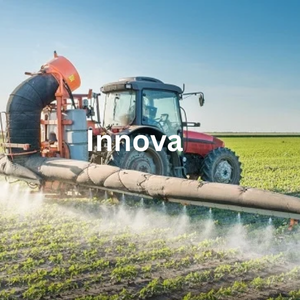
Innovacorp manufactures agriculture chemicals for US farming conditions. Our range covers soil conditioners, soil pH balancers and super absorbent polymers (SAP). These are not crop protection chemicals. They work on the soil itself, correcting the conditions that limit how well applied fertilizer and irrigation water actually perform. For US growers dealing with variable soil types, water retention issues and pH imbalance, this is where the input efficiency problem usually starts.
US agriculture is large-scale and input-intensive. Corn planted area alone was estimated at over 95 million acres in 2025 [citation:3]. When you farm at that scale, small inefficiencies compound quickly. A soil conditioner that improves water-holding capacity, or a pH balancer that brings the root zone into the right range, affects how every other input performs.
The problem is rarely a shortage of fertilizer. It is often that the soil locks nutrients into forms the plant cannot absorb. High pH, low organic carbon, and poor water retention all reduce fertilizer efficiency. Correcting those conditions at the root zone level is the first step before any nutrient programme can work at its best.
Our agriculture range is built around three product families:
The choice between a soil conditioner, a pH balancer and SAP depends on what is limiting the soil.
If water runs off or drains too fast: a soil conditioner or SAP is the first input to consider. Sandy soils and fields with low organic matter lose water below the root zone before the crop can use it. SAP holds that water in the root zone and releases it gradually. Soil conditioners improve structure so water infiltrates and stays available.
If fertilizer response is poor despite adequate application: check pH first. A pH balancer corrects the root zone before more fertilizer is spent. This is a common issue across fields with inconsistent pH from one end to the other.
If the field is already well-structured and pH is in range: SAP can still help during critical growth stages and in dryland blocks, but it is not a substitute for good soil management. The product works with existing practice, not instead of it.
Indicative values from our standard agriculture range. Final specification is confirmed against your soil report and crop plan. TDS is shared before order.
| Parameter | Typical Value |
|---|---|
| Appearance | Granular / powder |
| pH (1% solution) | 6.0 – 8.0 (product dependent) |
| Moisture Content | Max 10% |
| Organic Carbon (conditioners) | 15% – 30% |
| SAP Absorption Capacity | 200 – 500 times dry weight (grade dependent) |
| Shelf Life | 24 months from manufacture |
TDS on request. Values vary by product and grade.
Dosage depends on the product, crop and soil condition. The ranges below are starting points for a soil report review, not fixed field recommendations.
SAP should always be applied below the soil surface, not broadcast. Direct sunlight and air exposure reduce its effective life. For horticulture and high-value crops, dosage is usually calculated per plant rather than per acre, and that calculation depends on root zone volume and irrigation method.
Standard packing is 25 kg and 50 kg HDPE bags with inner liner. Jumbo bags are available on request. Store in a dry, covered area away from moisture and direct sunlight. Keep bags sealed until use. Moisture pick-up affects granule flow and product performance, so storage conditions before application matter as much as the product itself.
Soil conditions vary widely across US farming regions, and the same product does not perform the same way everywhere. A soil conditioner that works in one field can underperform in another because the organic matter, pH and water-holding capacity are different. We prefer to review your soil test report and crop plan before recommending a product and dosage. Share your field conditions with our technical team, and we will suggest a starting point for your own field trial. Call +91-9312871070.
Q. Which agriculture chemicals does Innovacorp manufacture for the US market?
We manufacture soil conditioners, soil pH balancers and potassium-based super absorbent polymers (SAP) for
agriculture. These are supplied to farms, cooperatives and agricultural input distributors in the US.
Q. How is dosage decided for soil conditioners in US field conditions?
Dosage depends on soil test results, crop type and existing soil condition. Typical starting ranges are 50
to 100 kg per acre for soil conditioners and 20 to 50 kg per acre for pH balancers. Final dosage is
confirmed after reviewing your soil report.
Q. Do you supply super absorbent polymers suitable for US dryland farming?
Yes. Our potassium-based SAP is designed for water retention in the root zone and is suitable for dryland
and irrigated farming. Typical dosage for field crops is 2.5 to 5 kg per acre, confirmed after soil and
rainfall assessment.
Q. How should agriculture chemicals be stored before field application?
Store in a dry, covered area away from moisture and direct sunlight. Keep bags sealed until use. Moisture
pick-up can affect granule flow and product performance, so storage conditions matter before application.
Call +91-9312871070 to discuss your soil conditions and request TDS for the product that fits your crop and field.
© 2026 Innovacorp India Pvt Ltd. All Rights Reserved. Managed & Developed by Innova Corporate India
 Chat with Us