
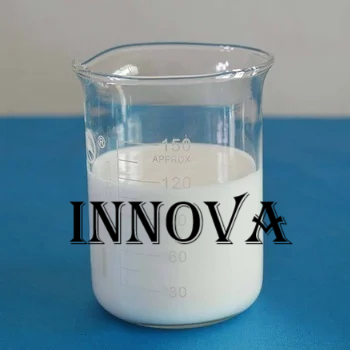
In Baddi's pharmaceutical belt, fermentation is not a side process. It is the core of API manufacturing for a significant share of the units in the Baddi-Barotiwala-Nalagarh corridor. And fermentation, by its nature, foams. The same aeration and agitation that keep the microbial culture alive also create surface foam that reduces working volume, stresses the exhaust system, and creates a contamination risk that no pharma unit can afford. Innovacorp supplies antifoaming agents for fermentation and process foam control in Baddi's pharma and industrial units — formulated to prevent foam formation rather than only breaking it after it appears.
In many industrial processes, foam is an inconvenience. In fermentation, it is a process constraint. Foam occupies volume that should be liquid. It can climb the bioreactor walls, reach the exhaust filter, and in the worst case, cause an overflow that compromises the batch. The foam layer also reduces the effective oxygen transfer area, which can slow microbial growth and reduce yield. And because fermentation batches run for hours or days, the antifoaming agent has to stay effective over that entire period without degrading, separating, or interfering with the downstream recovery steps. This is why a general-purpose defoamer is not automatically the right answer for fermentation. The chemistry has to be compatible with the biological system, and it has to be dosed in a way that prevents foam from taking hold.
The choice between silicone-based and non-silicone antifoaming agents depends on the process and the downstream steps. Silicone antifoams are typically more effective at lower doses and have good thermal stability, which matters in fermentation where temperatures are controlled but not always low. However, silicone residues can cause problems in later processing if the API or the formulation is sensitive to them. Non-silicone antifoams are often preferred where silicone contamination is a concern. For a Baddi pharma unit, the decision should be based on the product being made and the purification train, not on a generic product recommendation. If the downstream step involves filtration or chromatography, the antifoam choice can affect recovery. If the product is a topical formulation, silicone carryover may be acceptable. The grade selection is a process decision.
While pharma fermentation is the primary context, Baddi's industrial base has other foam-problem processes where an antifoaming agent prevents foam from forming in the first place:
Before choosing an antifoaming agent for a Baddi process, four questions matter:
Antifoaming agent dosage is not a single ppm figure. It depends on the foaming tendency of the specific broth or liquor, the aeration rate, and the temperature. A working approach for fermentation:
For textile and ETP applications, the dosage is set by the severity of the foam problem and the volume of the system. A small-scale trial is the fastest way to establish the working range.
| Parameter | Typical Value |
|---|---|
| Appearance | Liquid (emulsion or oil, grade-dependent) |
| Active content | TDS on request |
| pH (as supplied) | TDS on request |
| Specific gravity | TDS on request |
| Shelf life | TDS on request |
Specifications vary by product grade. TDS on request.
Standard industrial packing. Pack sizes on request.
Foam control in fermentation is a balance between preventing foam and not interfering with the biology. If you have a current foam problem, share the process details — the broth type, the aeration and agitation conditions, the temperature, and the downstream steps — and we can suggest a starting grade and dosage range. This is a component of the process; the full picture includes the bioreactor design, the exhaust system, and the recovery process.
During microbial fermentation, foam build-up reduces the working volume of the bioreactor, can cause overflow through exhaust lines, and increases the risk of contamination. It also reduces oxygen transfer efficiency. An antifoaming agent dosed continuously or as needed keeps foam from forming in the first place.
Silicone antifoams are typically more effective at low doses and have good thermal stability, but they can cause surface defects in downstream coating or printing processes. Non-silicone antifoams are often preferred where silicone contamination is a concern, such as in certain pharmaceutical processes or where the product is sensitive to silicone residues.
Dosage depends on the fermentation broth composition, the aeration and agitation rates, and the temperature. It is not a fixed number. Start with the supplier's recommended range, then adjust based on visual foam control and any impact on downstream processing. Overdosing can affect oxygen transfer and product recovery.
Not always. Fermentation requires compatibility with the biological system and the downstream purification steps. Textile processing has different requirements, including compatibility with dyes and finishing agents. The chemistry that works in one application may cause defects in another.
Call +91-9312871070 to discuss your foam control problem and request a grade recommendation.
© 2026 Innovacorp India Pvt Ltd. All Rights Reserved. Managed & Developed by Innova Corporate India
 Chat with Us