
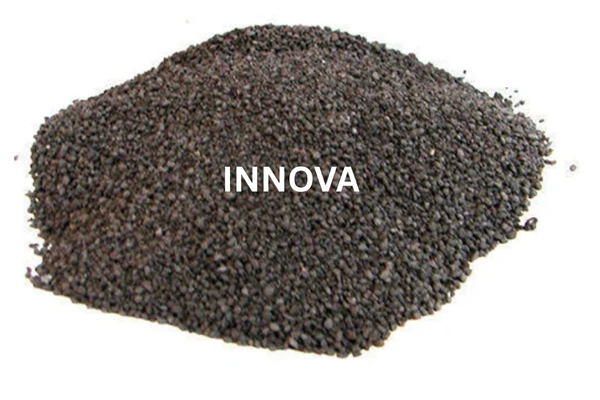
Innovacorp India manufactures Iron Removal Media in Baddi for plants dealing with dissolved iron in borewell and process water. The Baddi-Barotiwala industrial belt is known as Asia's largest pharmaceutical hub, with hundreds of formulation units drawing on groundwater that carries elevated iron levels. Our catalytic MnO2 media is designed to oxidise dissolved iron into a filterable form, helping plants protect downstream RO membranes, EDI units, and process equipment from iron fouling.
Groundwater studies in the Baddi-Barotiwala region have recorded iron concentrations ranging from below detection limit to 3.6 mg/l, with several locations exceeding permissible limits. For pharmaceutical formulation units, iron in feed water can interfere with purification trains, stain ion exchange resins, and foul reverse osmosis membranes. For other industrial units in Baddi—packaging, plastics, electrical goods, food processing—iron deposits reduce heat transfer efficiency and clog nozzles and pipelines. The problem is not uniform across the belt; it varies by borewell depth and location, which is why media sizing should follow a water analysis rather than a standard assumption.
MnO2-based media work by catalysing the oxidation of soluble ferrous iron (Fe2+) into insoluble ferric hydroxide (Fe3+), which is then trapped within the filter bed. Unlike simple sand filters, catalytic media accelerate this reaction without requiring continuous chemical dosing, provided the water has adequate dissolved oxygen and the pH is within the media's operating range. In Baddi's industrial estate, where borewell water chemistry can shift between seasons, the media's backwash capability matters as much as its oxidation capacity. Regular backwashing removes accumulated iron floc and restores the bed's contact surface.
Media selection depends on three inputs: feed iron concentration, flow rate, and target outlet iron level. For pharma pre-treatment where RO membranes follow, a tighter outlet specification usually calls for deeper bed depth or a two-stage arrangement. For general industrial use where the downstream requirement is less stringent, a single bed may suffice. If your water also contains manganese or arsenic—both reported in the region's groundwater studies—the media grade and contact time need to be reviewed separately. Final selection should follow a lab trial with your actual water sample.
Typical parameters reviewed for catalytic iron removal media include MnO2 content, bulk density, effective size, uniformity coefficient, and backwash expansion characteristics. Because media performance depends on the specific water chemistry of your borewell or process stream, we share detailed specifications only after reviewing your water analysis. TDS on request.
Dosage is expressed as bed depth and flow rate per unit area rather than a chemical dose. For a given iron load, the required bed volume is calculated from the flow rate and the target contact time. As a starting point for discussion, media beds are typically designed for empty bed contact time (EBCT) in the range of 5–15 minutes, depending on iron concentration and outlet requirement. This is a design range, not a fixed specification—final sizing must be confirmed with your water analysis and pilot data.
Standard industrial packing; pack sizes on request.
We help plant engineers and water treatment contractors in Baddi review their water analysis, select a media grade, and plan backwash parameters. For systems already in operation, we can discuss troubleshooting symptoms such as premature iron breakthrough, excessive pressure drop, or short backwash cycles. Final media performance should be verified through a trial with your actual water.
Q: Baddi pharma plant ke liye iron removal media kaise select karein?
A: Feed water ka iron concentration aur flow rate pehle measure karein. MnO2 catalytic media un systems ke liye suitable hai jahan dissolved iron (Fe2+) ko Fe3+ mein oxidise karke filter bed mein capture karna ho. RO ya EDI se pehle pre-treatment stage pe media bed design kiya jata hai. Final media grade aur bed depth lab trial ke baad confirm karein.
Q: Baddi groundwater mein iron kitna hota hai?
A: Published groundwater studies Baddi-Barotiwala industrial belt mein iron concentrations ko BDL se 3.6 mg/l tak report karte hain, jo kai locations pe permissible limit se upar hai. Actual level source-to-source vary karta hai. Aapke borewell ka exact iron level test karwa kar media sizing decide karein.
Q: MnO2 media ki backwash frequency kya honi chahiye?
A: Backwash frequency feed water ki iron load aur media bed size pe depend karti hai. Jab pressure drop badhe ya effluent turbidity increase ho, backwash karein. Typical practice mein differential pressure 0.5–0.8 bar aane par backwash schedule kiya jata hai. Exact frequency aapke system ke operating data se tune karein.
Q: Iron removal media RO pre-treatment ke liye suitable hai?
A: Haan, MnO2 catalytic media ko RO membranes se pehle iron removal stage ke roop mein use kiya ja sakta hai, taaki membrane fouling kam ho. Media bed ke outlet pe iron level RO feed specification ke andar hona chahiye. System design ke liye aapke water analysis aur RO feed requirements share karein.
Call +91-9312871070 to discuss your Baddi water analysis and media selection.
© 2026 Innovacorp India Pvt Ltd. All Rights Reserved. Managed & Developed by Innova Corporate India
 Chat with Us