
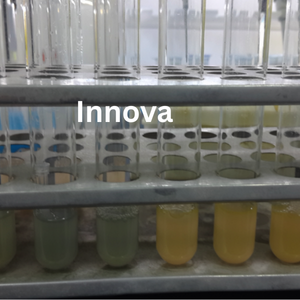
Baddi's textile dyeing units have a colour problem that is difficult to hide. Dye baths discharge effluent with visible colour, and when that effluent reaches the common treatment plant or the river, it is noticed — by regulators, by downstream users, and by the unit's own compliance team. Innovacorp supplies cationic polymer colour precipitants for textile effluent decolourization in Baddi's dyeing units and ETPs. The chemistry binds with dissolved dye molecules, forms flocs, and removes colour before the effluent leaves the unit.
Baddi's textile cluster is not a small operation. The belt has 97 textile units employing over 11,000 people. The common effluent treatment plant that serves the dyeing units has faced regulatory scrutiny for not meeting discharge standards, and textile units contributing high-load effluent have been issued closure directions and environmental compensation. The message is clear: colour and COD load at the inlet of the CETP matters, and units that do not manage their effluent face consequences. Colour precipitants are one tool in the unit's pretreatment programme, not a complete solution — but for dye effluent, colour is the most visible problem, and the one that triggers complaints.
Most reactive, acid, and direct dyes carry a negative charge in aqueous solution. The colour precipitant is a high-molecular-weight cationic polymer with a positive charge. When dosed into the effluent, three things happen:
The chemistry is not the same as a standard coagulant like alum or PAC. Those work by charge neutralisation and sweep flocculation, but they are not designed for the soluble dye molecules that pass through conventional treatment. The cationic polymer is specifically effective on the dissolved colour that remains after primary treatment.
The dosing point matters as much as the chemistry. A typical sequence for dye effluent treatment:
| Treatment Stage | Function | Colour Precipitant Role |
|---|---|---|
| Equalization | Homogenise flow and load | Not dosed here — variability makes control difficult |
| Primary coagulation/flocculation | Remove suspended solids and some colour | Can be dosed alongside or after coagulant |
| Secondary treatment | Biological COD removal | Not effective on colour; colour persists through biological treatment |
| Tertiary polishing | Final colour and COD reduction | Primary dosing point — before filtration or DAF |
In many Baddi units, colour precipitant is dosed after biological treatment but before the final clarification or filtration step. This targets the residual colour that biological treatment cannot remove. The exact point depends on the ETP configuration and the CETP's inlet requirements.
Colour precipitant dosage is not a fixed ppm figure. It depends on the dye concentration, the dye class (reactive, acid, disperse), the effluent pH, and the target colour removal. A working approach:
Final dosage is confirmed after reviewing your effluent characteristics and treatment train. Dosing without a jar test is a guess, and in a compliance-driven environment, a guess can cost more than the chemical.
Colour removal is one step in the effluent treatment sequence. Baddi's textile and process units also need polyelectrolyte flocculants for sludge conditioning and settling, chlorine tablets for final disinfection, and industrial biocides for cooling water systems.
| Parameter | Typical Value |
|---|---|
| Appearance | Liquid (grade-dependent) |
| Charge | Cationic |
| Active content | TDS on request |
| pH (as supplied) | TDS on request |
| Specific gravity | TDS on request |
| Shelf life | TDS on request |
Specifications vary by product grade. TDS on request.
Standard industrial packing. Pack sizes on request.
Colour removal from dye effluent is a chemistry-and-dose problem that has to be solved on the actual effluent. Share the effluent characteristics — dye class, colour load, pH, and the treatment train — and we can suggest a starting grade and jar test protocol.
Dyeing processes generate effluent with high colour load from unfixed dyes. Baddi's CETP has specific inlet quality requirements, and textile units contributing high-colour effluent have faced regulatory action. Colour precipitants help reduce the colour load before the effluent reaches the CETP or the unit's own ETP.
Most textile dyes carry a negative charge in water. Cationic polymers carry a positive charge and bind with these dye molecules, neutralising the charge and forming insoluble flocs. These flocs can then be removed by settling or filtration, reducing the colour of the treated water.
Colour precipitants are one treatment step. They reduce colour load, but the effluent also needs pH adjustment, suspended solids removal, and possibly biological treatment depending on the CETP's requirements. The precipitant dose and point of addition need to be matched to the specific effluent characteristics of the unit.
Dosage depends on the dye concentration, the type of dyes used, the effluent pH, and the target colour removal. It is not a fixed ppm figure. A jar test on the actual effluent is the standard way to establish the starting dose before full-scale dosing.
Call +91-9312871070 to discuss your effluent characteristics and request a jar test protocol.
© 2026 Innovacorp India Pvt Ltd. All Rights Reserved. Managed & Developed by Innova Corporate India
 Chat with Us