
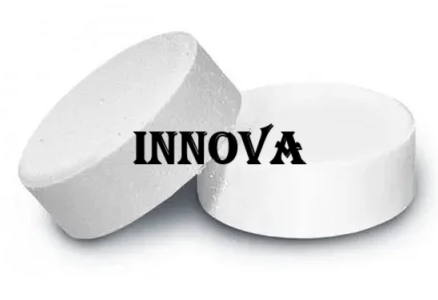
Baddi's industrial units run on water — cooling towers on the roof, process water loops behind the production hall, effluent treatment plants before discharge. Each of these systems needs microbial control, and each one has different constraints. Chlorine tablets offer a simple, controlled way to maintain a disinfectant residual without the handling complexity of gas or liquid chlorine. Innovacorp supplies TCCA 90 and SDIC chlorine tablets for cooling towers, water treatment, and effluent disinfection in Baddi's pharmaceutical and process units.
The two main chlorine tablet chemistries behave differently, and the choice depends on what the system needs:
| Property | TCCA 90 | SDIC |
|---|---|---|
| Available chlorine | ~90% | ~56–60% |
| Dissolution rate | Slow, controlled release | Fast dissolution |
| pH (1% solution) | Acidic (2.7–3.3) | Near-neutral (5.5–7.0) |
| Best for | Continuous disinfection: cooling towers, storage tanks | Shock treatment, immediate disinfection |
For a cooling tower that runs continuously, TCCA 90 tablets maintain a residual over time with less frequent dosing. For a system that needs a quick microbial knock-down, SDIC dissolves faster and delivers chlorine immediately. The choice is not about which is "better" — it is about which matches the system's operating pattern.
Baddi's industrial mix — 321 pharmaceutical formulation units, plus textile dyeing, food processing, cosmetics, and chemical units — creates demand for water disinfection at several points:
Chlorine tablets are not the right choice for every scale of operation. A large municipal water plant needs a dosing system and bulk chemical supply. But for a mid-sized industrial unit in Baddi, tablets offer practical advantages:
Chlorine tablet dosage depends on the water volume, the organic load, and the target residual. A working approach:
Final dosage is confirmed after reviewing your water analysis and system data. Overdosing wastes chemical and can create corrosion or by-product issues; underdosing leaves the system unprotected.
Chlorination is one part of a water treatment programme. Baddi's process units also need non-oxidizing biocides for systems where chlorine is not suitable, boiler water treatment chemicals for steam systems, and polyelectrolyte flocculants for effluent clarification and sludge dewatering.
| Parameter | TCCA 90 | SDIC |
|---|---|---|
| Appearance | White tablets | White tablets |
| Available chlorine | 90% min | 56–60% |
| Tablet weight | 20g / 50g / 200g | TDS on request |
| Shelf life | 24 months | TDS on request |
Specifications vary by product grade. TDS on request.
Standard industrial packing. Pack sizes on request.
Chlorine tablet selection depends on the system — the volume, the organic load, and the residual target. Share the application details and we can suggest the tablet type and a starting dosage range for your system.
TCCA 90 contains 90% available chlorine and dissolves slowly, making it suitable for continuous disinfection in cooling towers and water systems. SDIC contains around 56-60% available chlorine and dissolves faster, which makes it suitable for shock treatment or applications where immediate disinfection is needed.
Yes. Chlorine tablets are used to control algae, bacteria, and biofilm in recirculating cooling water. The slow-dissolving TCCA 90 form maintains a residual chlorine level over time, which suits continuous cooling tower operation. The dosage depends on the system volume and microbial load.
Chlorine tablets can be used for final disinfection of treated effluent before discharge. The dosage depends on the residual chlorine target and the organic load of the treated water. For a CETP or large ETP, the tablet form may be less practical than a dosing system, but for smaller ETPs or polishing stages, tablets offer a simple dosing method.
Dosage depends on the water volume, organic load, and target free chlorine residual. For cooling towers, a common approach is to dose based on microbial count and maintain a residual in the circulating water. For water treatment, the target residual is typically 1-3 ppm. Final dosage is confirmed after testing your specific water quality.
Call +91-9312871070 to discuss your water system and request a tablet selection guide.
© 2026 Innovacorp India Pvt Ltd. All Rights Reserved. Managed & Developed by Innova Corporate India
 Chat with Us