
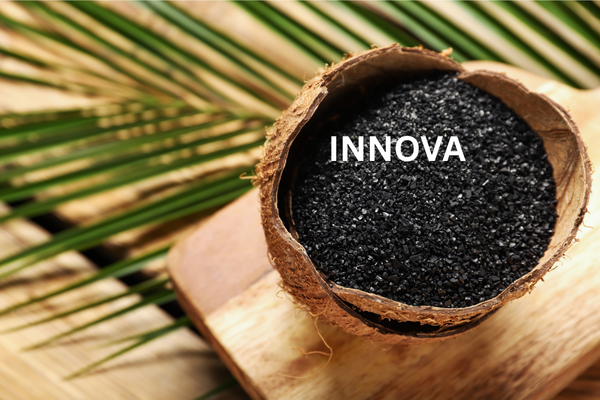
Activated carbon has one job, done well: it pulls dissolved organic compounds — colour bodies, odour molecules, residual chlorine, trace organics — out of a liquid stream and holds them on its internal surface. Two bags labelled "activated carbon" can behave very differently once they are in a column or a batch tank, because iodine value, mesh size, raw material and pore structure decide what the carbon actually captures. In Nepal, three types of buyers keep asking for it. Pharmaceutical units in the Kathmandu valley need carbon for API purification and process water. Water treatment plants across the Terai belt need carbon for dechlorination and organics removal. Beverage and food processors need carbon for taste, odour and colour control. Innovacorp manufactures and supplies activated carbon for these three groups in Nepal, across PAC and GAC grades in coal, coconut shell and wood-based substrates. The conversation starts with your application and process data, not a fixed grade chart.
Activated carbon works by adsorption. Dissolved molecules stick to the internal surface of the carbon as the liquid passes through or mixes with it. What it handles well:
What it does not remove well: dissolved salts (that is ion exchange or RO territory), hardness (softener territory) and most microorganisms (disinfection territory). Before choosing a grade, the first question is always: what exactly do you need removed?
Grade selection depends on your application, the contaminants you need to remove and the contact time available. We do not recommend a fixed grade for every plant.
| Application | Grade family | Selection driver |
|---|---|---|
| Pharma process water | GAC (coconut shell) | Organics removal, TOC reduction |
| Pharma API purification | PAC (coconut shell) | Decolorization, impurity removal |
| Water treatment — dechlorination | GAC (coal) | Residual chlorine removal ahead of RO |
| Water treatment — organics | GAC (coal) | Humic substances, colour removal |
| Beverage taste and odour | PAC or GAC (coconut) | Taste, odour and colour control |
| ETP polishing | GAC (coal) | Residual organics removal |
Iodine value, mesh size and substrate are confirmed against your feed analysis and target treated water quality. Final selection is agreed after reviewing your application data.
Grade-wise technical data — iodine value, surface area, bulk density, ash content, pH and shelf life — is shared as a TDS on request for the specific grade under consideration. Final specification is confirmed against the product TDS before dispatch.
Activated carbon dosing is set on the contaminant load and contact time, not a fixed rate. Working reference ranges for Nepal plants:
These are starting ranges. Final dosage is confirmed after reviewing your application data, and our team reviews the numbers with your plant engineer before the first charge.
Standard industrial packing; pack sizes on request.
We do not sell bags and walk away. For pharma units, water treatment plants, beverage processors and industrial users in Nepal, we review your application data, go through the grade selection with your engineer, and review the loading data and commissioning checklist with your team remotely. If treated water quality starts drifting, call us — we will look at the operating data with you. TDS is shared on request.
Innovacorp manufactures powdered activated carbon (PAC) and granular activated carbon (GAC) in coal-based, coconut-shell and wood-based variants. The right grade for a pharma or water plant in Nepal depends on iodine value, mesh size and the contaminants being targeted. Share your process data and we can advise on the suitable grade.
For pharmaceutical use, selection depends on the process stage — decolorization, API purification or pyrogen removal. Iodine value, mesh size and purity are matched to your process. Final specifications are confirmed after a lab trial with your team.
Yes. PAC is used for taste, odour and colour removal in municipal and industrial water treatment, while GAC is used in fixed-bed columns for continuous organic removal. The choice depends on your plant's contact time, dosing point and discharge limits.
Activated carbon should be stored in a dry, covered area away from moisture and strong odours. Once a bag or drum is opened, reseal it to prevent adsorption of ambient vapours. Follow the storage guidance on the TDS for the specific grade.
Tell us whether your plant is pharma, water treatment or beverage, and share your feed analysis and target treated quality. We will suggest the grade and the working dose range for your plant. Call +91-9312871070.
© 2026 Innovacorp India Pvt Ltd. All Rights Reserved. Managed & Developed by Innova Corporate India
 Chat with Us