
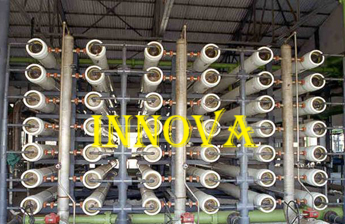
An RO membrane is expensive, and it fails in predictable ways. Calcium carbonate scale forms on the last elements when the recovery is pushed too high for the feed water chemistry. Silica polymerises on the membrane surface and cannot be removed with a standard acid CIP. Biofilm builds up on the feed spacer and raises the differential pressure across the train. Colloidal clay and silt from a borewell feed deposit on the first elements and drop the flux. Innovacorp manufactures and supplies RO membrane chemicals for Nepal plants — antiscalants, acidic and alkaline CIP cleaners, non-oxidizing biocides and colloidal dispersants — selected on the feed water chemistry and the membrane type, not on a fixed catalogue. The working conversation starts with your feed water analysis, not a fixed dose chart.
Not every fouling problem is the same, and not every chemical fixes every problem:
A single antiscalant that handles calcium carbonate may not handle silica. That is why the grade selection is set on the feed water analysis — silica, calcium, barium, strontium, and the Langelier Saturation Index (LSI) — not on a fixed "RO antiscalant" label.
| Product family | What it does | Where it is used |
|---|---|---|
| RO antiscalant | Threshold inhibition of calcium carbonate, sulfate and silica scale on the membrane surface. | Feed water line, dosed continuously. |
| Acidic CIP cleaner | Removes mineral scale and metal hydroxides from the membrane surface. | Periodic CIP, when the differential pressure or the salt passage rises. |
| Alkaline CIP cleaner | Removes organic and biological fouling from the feed spacer and the membrane. | Periodic CIP, often preceded by an alkaline clean and followed by an acid clean. |
| Non-oxidizing biocide | Controls microbial growth in the feed and the pre-treatment train without attacking the membrane. | Pre-treatment, dosed ahead of the membrane. |
| Colloidal dispersant | Keeps clay, silt and metal hydroxides in suspension so they leave in the reject. | Feed water line, where the feed carries colloidal load. |
The product mix and the dose are confirmed after a feed water analysis. We do not recommend a fixed package — the feed chemistry and the membrane type decide.
Grade-wise technical data — appearance, active content, pH, density and shelf life — is shared as a TDS on request for the specific product under consideration. Final specification is confirmed against the product TDS before dispatch.
Dose is set on the feed water chemistry and the system recovery, not a fixed figure per cubic metre. Working reference ranges for Nepal plants:
These are starting ranges. The working dose is confirmed from your feed water analysis and the TDS for the product. Our team reviews the dosing plan with your plant engineer before the first charge.
Standard industrial packing; pack sizes on request.
For industrial RO plants in Nepal — boiler feed, pharma, food-grade, power plant DM and wastewater recovery — we review your feed water analysis, go through the product selection with your plant engineer, and review the dosing plan before the first charge. If the differential pressure, flux or salt passage starts drifting, call us — we will look at the operating data with you. The industrial biocides page covers the wider microbial control programme, which is linked to the biofilm side of membrane fouling. TDS is shared on request.
Innovacorp manufactures RO antiscalants, acidic and alkaline CIP cleaners, non-oxidizing biocides and colloidal dispersants for industrial RO plants in Nepal. The product mix is set after a feed water analysis, not on a fixed package.
Silica is a different problem from calcium carbonate — a standard antiscalant that handles carbonate scale may not hold silica in suspension at the same recovery. The antiscalant selection depends on the silica concentration, the recovery rate and the membrane type. We confirm the grade after a feed water analysis and a projection of the scaling potential at your recovery.
An antiscalant is dosed continuously into the feed water to prevent scale from forming on the membrane surface. A CIP (Clean-In-Place) cleaner is used periodically to remove the fouling that has already formed — acidic cleaners for mineral scale, alkaline cleaners for organic and biological fouling. The two are used together in a membrane maintenance programme, not as alternatives.
Store in the original container, in a cool, dry, ventilated area away from direct sunlight and incompatible chemicals. Keep the lid tight when not in use and follow the handling guidance on the TDS. Do not mix with other chemicals in the storage area.
Send us your feed water analysis — silica, calcium, barium, strontium, LSI and the target recovery — along with the membrane type and the current CIP cycle, and we will suggest the product mix and a working dose range for your RO plant. Call +91-9312871070.
© 2026 Innovacorp India Pvt Ltd. All Rights Reserved. Managed & Developed by Innova Corporate India
 Chat with Us