
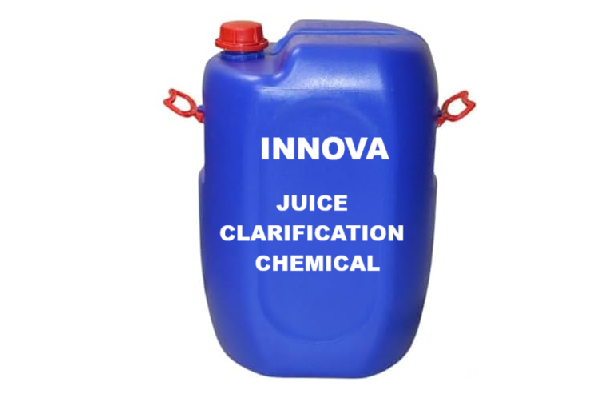
Innovacorp India Pvt Ltd manufactures and supplies juice clarification chemicals for sugar mills in Nepal. The program covers flocculants, pH control chemicals, and settling aids used at the clarifier. Technical support is provided remotely from our New Delhi office.
Clarification is not a single chemical step. It is a sequence. First, the juice pH is set to the range where the impurities are least soluble. Second, a coagulant or pH control chemical destabilises the colloidal particles. Third, a flocculant binds those particles into flocs. Fourth, the flocs settle, and the clear juice is decanted from the top. If any step is out of balance, the clarifier underperforms — either the flocs are too small to settle, or the mud is too bulky to filter, or the clarified juice still carries colour. This is why a clarification program is set as a whole, not as separate products.
| Component | Role at the Clarifier | Typical Dose Range |
|---|---|---|
| pH control chemical | Sets juice pH to the range where impurities precipitate and clarification works. | Set by juice pH — finalised after jar test. |
| Coagulant | Destabilises colloidal particles so they can come together. | Set by turbidity — finalised after jar test. |
| Flocculant | Binds destabilised particles into flocs that settle and filter cleanly. | 1 to 10 ppm on juice — finalised after jar test. |
The flocculant is the last chemical added before the clarifier. It is a high-molecular-weight polymer — anionic for cane juice clarification — that bridges across multiple particles and binds them into a floc. The floc needs to be large enough to settle, but not so large that it traps juice and increases sucrose loss in the mud. Dose, preparation concentration, and dosing point all affect this balance. We set the dose after a jar test on your juice, using your process conditions.
Flocculant is prepared as a dilute solution — typically 0.1 to 0.5 percent — in a dedicated dosing tank with slow agitation. The solution is aged for a defined time and then dosed into the juice line ahead of the clarifier. pH control chemicals and coagulants are dosed separately, upstream of the flocculant. The dosing sequence matters — if the flocculant is added before the pH is in range, the flocs will not form properly.
| Parameter | Typical Value |
|---|---|
| Appearance | Varies by component — TDS on request |
| Active content | Product-specific — TDS on request |
| pH (as supplied) | Product-specific — TDS on request |
| Density | TDS on request |
| Application point | Clarifier — TDS on request |
| Shelf life | TDS on request; store in original packaging away from moisture and direct sunlight |
Final specification is set after a jar test on your juice.
Pack sizes for a specific mill loading are shared on request.
Flocculant removes suspended solids and turbidity. Colour reduction requires a separate decolorizing step downstream — flocculant alone will not lower ICUMSA colour. The program also relies on a jar test to set the dose; every mill's juice is different, and the dose is set on your juice, not from a general table. Within those limits, the program helps the clarifier remove suspended solids cleanly and supports filtration.
We work with your process team on jar tests, dose setting, preparation setup, and dosing point selection. Support is provided remotely from our New Delhi office, and follow-up on trial results is handled with your process team. For a technical discussion, call +91-9312871070.
We manufacture and supply flocculants, pH control chemicals, and settling aids for juice clarification in Nepal sugar mills. The product mix is set after a jar test on your juice.
Flocculant is the polymer that binds suspended particles into flocs. pH control chemicals set the juice pH in the range where clarification works best. Settling aids support the floc structure. Each has a separate role, and the program is set after a jar test.
Dosage depends on the mud volume, juice pH, and clarifier design. Flocculant is typically dosed at 1 to 10 ppm on juice, with pH control and settling aids set accordingly. The dose is set after a jar test on your juice.
Powder grades are supplied in 5 kg, 25 kg and 50 kg bags, and liquid grades in 5 L, 20 L, 35 L and 200 L HDPE carboys and drums. Pack sizes for a specific mill loading are shared on request. Call +91-9312871070 for a technical discussion.
For jar test support, dosage guidance or TDS, call +91-9312871070. If your mill is also reviewing the flocculant grade in detail, the anionic flocculant for sugar juice clarification in Nepal page covers the single-product selection and preparation. For the evaporator stage that follows clarification, the evaporator anti-scalants for Nepal sugar mills page covers scale control and dosage for juice heaters and evaporator bodies.
© 2026 Innovacorp India Pvt Ltd. All Rights Reserved. Managed & Developed by Innova Corporate India
 Chat with Us