
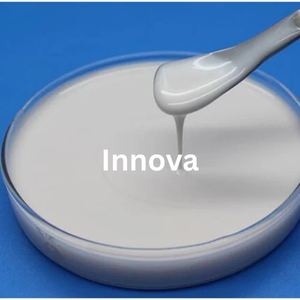
A thickener does not just make a fluid thicker. It changes how the fluid behaves under shear — which is what matters in a pump, a pipe, a mixing tank or a settling basin. A shear-thinning thickener flows easily when pumped, but stays thick when standing, so it can carry suspended solids without settling out. In wastewater treatment, the thickener is used in the sludge thickening step ahead of the dewatering equipment. In paint and chemical formulations, the same chemistry is used for rheology control. In both cases, the polymer chemistry and the molecular weight decide how the fluid behaves. Innovacorp manufactures and supplies industrial thickeners for Nepal — polyacrylamide-based rheology modifiers for wastewater, paint and process applications — selected on the application and the shear profile, not on a fixed catalogue grade.
Thickeners serve two different purposes, and the grade selection is different for each:
The two applications use different molecular weights and different charge types. A thickener for paint is not the same grade as a thickener for sludge. The grade selection is set on the application, not on a general "thickener" label.
Shear-thinning means the fluid's viscosity drops when it is sheared — pumped, stirred or poured — and recovers when the shear stops. The behaviour is useful because:
The polymer chemistry and the molecular weight determine the shear-thinning behaviour. A high molecular weight polymer gives more shear-thinning; a low molecular weight polymer gives a more Newtonian behaviour. The grade is selected on the application and the flow profile.
| Product form | Where it is used | Typical dose |
|---|---|---|
| Polyacrylamide thickener (powder, anionic / cationic / non-ionic) | The standard form — dissolved in a make-up tank and dosed as a dilute solution. | Set on the jar test and the application. |
| Polyacrylamide thickener (emulsion, where applicable) | Where the plant prefers a liquid product and the storage space is limited. | Set on the jar test and the application. |
The exact product form and dose are confirmed after a jar test on the actual sludge or the formulation. We do not recommend a fixed package — the application and the flow profile decide.
Grade-wise technical data — appearance, molecular weight, charge density, dissolution time and shelf life — is shared as a TDS on request for the specific product under consideration. Final specification is confirmed against the product TDS before dispatch.
Dose is set on the application and the flow profile, not a fixed figure per cubic metre. Working reference approaches for Nepal plants:
These are starting approaches. The working dose is confirmed from your jar test and the TDS for the product. Our team reviews the dosing and preparation plan with your plant engineer before the first charge.
Standard industrial packing; pack sizes on request.
For industrial plants in Nepal — wastewater, paint, chemical and process — we review your jar test data or formulation requirements, go through the product selection with your plant engineer, and review the dosing and preparation plan before the first charge. If the viscosity, the settling behaviour or the dewatering performance starts drifting, call us — we will look at the operating data with you. The microbial culture page covers the biological side of the ETP, which is a separate treatment stage. TDS is shared on request.
A thickener increases the viscosity of a fluid, which can serve two purposes: it keeps suspended solids from settling too quickly (suspension stability), or it thickens a sludge or slurry for easier handling (sludge thickening). In wastewater treatment, the thickener is used in the sludge thickening step ahead of dewatering. In paint and chemical formulations, it is used for rheology control. The grade selection depends on the application.
Shear-thinning means the fluid's viscosity drops when it is sheared — pumped, stirred or poured — and recovers when the shear stops. This is useful because the fluid flows easily through a pump or a pipe, but stays thick when standing or when applied to a surface. A paint that is shear-thinning stays on the brush without dripping; a sludge that is shear-thinning pumps easily but settles in the thickener. The polymer chemistry and the molecular weight determine the shear-thinning behaviour.
The selection depends on the sludge character, the thickener type and the downstream dewatering step. A cationic polymer is the common choice for biological sludge; an anionic or non-ionic grade may be used for mineral sludge. The dose and the molecular weight are set on a jar test on the actual sludge, not on a fixed catalogue grade.
Store the powder in the original container, in a cool, dry, ventilated area away from direct sunlight and moisture. Prepare the working solution in a clean tank with gentle agitation, and use it within the recommended shelf life of the solution — the polymer degrades over time if left standing. Follow the handling guidance on the TDS.
Send us your application data — sludge characterisation, formulation requirements or slurry properties — along with the application (wastewater, paint, chemical), and we will suggest the product form and a working dose range for your plant. Call +91-9312871070.
© 2026 Innovacorp India Pvt Ltd. All Rights Reserved. Managed & Developed by Innova Corporate India
 Chat with Us