
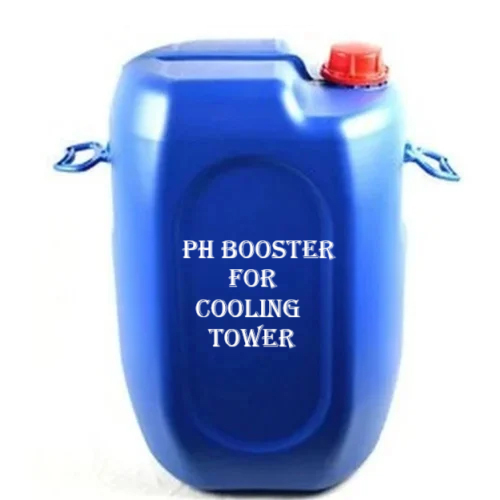
Cooling water has a narrow comfortable band. If the pH drifts acidic, the metal surfaces in the heat exchanger and the basin start to pit, and the corrosion rate climbs. If the pH drifts too alkaline, calcium carbonate scale deposits on the hot surfaces, and the heat transfer drops. The Langelier Saturation Index (LSI) is the single number that captures this balance, and a pH booster is one of the levers used to hold it. Innovacorp manufactures and supplies pH boosters for cooling water systems in Nepal — alkalinity builders that shift the LSI towards the slightly scale-forming side, where a thin protective film forms on the metal — selected on the cooling water chemistry, not on a fixed catalogue grade.
Two failure modes sit on either side of the pH band:
The LSI combines pH, calcium hardness, total alkalinity, temperature and dissolved solids. A negative LSI means the water is corrosive; a positive LSI means it is scale-forming. The pH booster is one of the three or four levers used to hold the LSI in the target band, alongside the scale inhibitor, the corrosion inhibitor and the cycles of concentration.
| Product form | Where it is used | Typical dose |
|---|---|---|
| Liquid pH booster (standard) | Continuous dosing into the circulating water or the make-up line. | Set on the pH, alkalinity and LSI of the circulating water. |
| Liquid pH booster (concentrated) | Where the storage space is limited and the dose volume has to be lower. | Set on the circulating water chemistry. |
| Powdered pH booster | For plants that prefer batch preparation in a dosing tank. | Set on the circulating water chemistry and the dosing setup. |
The exact product form and dose are confirmed after a cooling water analysis. We do not recommend a fixed package — the water chemistry and the system decide.
Grade-wise technical data — appearance, active content, pH of the concentrate, density and shelf life — is shared as a TDS on request for the specific product under consideration. Final specification is confirmed against the product TDS before dispatch.
Dose is set on the current pH, alkalinity and LSI of the cooling water, not a fixed figure per cubic metre. Working reference ranges for Nepal plants:
These are starting approaches. The working dose is confirmed from your cooling water analysis and the TDS for the product. Our team reviews the dosing plan with your plant engineer before the first charge.
Standard industrial packing; pack sizes on request.
For cooling towers, chiller loops and heat exchangers in Nepal, we review your cooling water analysis, go through the product selection with your plant engineer, and review the dosing plan before the first charge. If the LSI or the corrosion rate starts drifting, call us — we will look at the operating data with you. The industrial biocides page covers the microbial side of the cooling water programme, which is linked to the organic acid load that affects the pH. TDS is shared on request.
A pH booster raises the alkalinity of the cooling water, which shifts the Langelier Saturation Index (LSI) towards the slightly scale-forming side — the side where a thin protective film forms on the metal surface. That film is what limits acidic pitting in the heat exchangers. The product is dosed into the circulating water or the make-up water, depending on the system layout.
The Langelier Saturation Index combines pH, calcium hardness, total alkalinity, temperature and dissolved solids into a single number. A negative LSI means the water is corrosive; a positive LSI means it is scale-forming. The target is a slightly positive LSI — enough to form a protective film, not so positive that scale deposits. A pH booster is one of the levers used to hold the LSI in that band, alongside the scale inhibitor and the cycles of concentration.
Dose is set on the current pH, alkalinity and LSI of the cooling water, not a fixed figure per cubic metre. The product is dosed into the circulating water or the make-up water, with the dose adjusted as the cycles of concentration and the make-up water chemistry change. Working ranges are confirmed from your cooling water analysis and the TDS for the grade.
Store in the original container, in a cool, dry, ventilated area away from direct sunlight and incompatible chemicals. Keep the lid tight when not in use and follow the handling guidance on the TDS. Do not mix with other chemicals in the storage area.
Send us your cooling water analysis — pH, total alkalinity, calcium hardness, temperature and conductivity — along with the system type (open tower, closed chiller loop or heat exchanger), and we will suggest the product form and a working dose range for your plant. Call +91-9312871070.
© 2026 Innovacorp India Pvt Ltd. All Rights Reserved. Managed & Developed by Innova Corporate India
 Chat with Us