
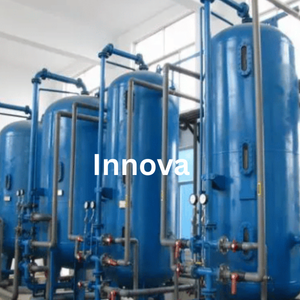
A boiler that runs on hard feed water and a loose blowdown schedule tells you something is wrong long before it fails: the stack temperature climbs, the fuel bill follows, and the tube sheet starts to show the first hard deposits. In Nepal's industrial steam plants — sugar mills, cogeneration units, pharmaceutical and food processing boilers — the water chemistry varies widely with the source, and the treatment programme has to be built around the analysis, not around a fixed product package. Innovacorp manufactures and supplies boiler water treatment chemicals for industrial plants in Nepal — scale inhibitors, sludge conditioners, oxygen scavengers, alkalinity builders and condensate treatment chemicals — selected on the feed water and boiler water analysis, not on a fixed catalogue.
A boiler water programme has four distinct problems to handle, and they need different chemistries:
No single product handles all four. The programme is set on the water analysis, the boiler pressure and the blowdown practice — and it is reviewed through the year as the feed water quality changes.
| Product family | What it does | Typical dose |
|---|---|---|
| Scale inhibitors (antiscalants) | Keeps calcium and silica in suspension so they leave with the blowdown. | 5–30 ppm in boiler water — confirmed after analysis. |
| Sludge conditioners (dispersants) | Keeps suspended solids fluid and removable through blowdown. | 5–20 ppm in boiler water — confirmed after analysis. |
| Oxygen scavengers | Removes dissolved oxygen before it causes pitting in the boiler and the economiser. | Set on the dissolved oxygen in the feed water. |
| Alkalinity builders | Holds boiler water pH in the mildly alkaline band and supports the magnetite layer. | Set on boiler water pH and total alkalinity. |
| Condensate treatment chemicals | Neutralises carbonic acid in the condensate return, protects the return lines. | Set on condensate pH and CO₂ load. |
The exact product mix and dose are confirmed after a feed water and boiler water analysis. We do not recommend a fixed package for every plant — the water chemistry decides.
Grade-wise technical data — appearance, active content, pH, density and shelf life — is shared as a TDS on request for the specific product under consideration. Final specification is confirmed against the product TDS before dispatch.
Dose is set on the feed water and boiler water analysis, not a fixed figure per tonne of steam. Working reference ranges for Nepal plants:
These are starting ranges. The working dose is confirmed from your water analysis and the TDS for the product, and it is adjusted through the year as the feed water quality changes. Our team reviews the dosing plan with your boiler engineer before the first charge.
Standard industrial packing; pack sizes on request.
For industrial boilers in Nepal — sugar mills, cogeneration units, pharmaceutical and food processing plants — we review your feed water and boiler water analysis, go through the product selection with your boiler engineer, and review the dosing plan before the first charge. If boiler water pH, dissolved oxygen or condensate pH starts drifting, call us — we will look at the operating data with you. TDS is shared on request.
Innovacorp manufactures scale inhibitors, sludge conditioners, oxygen scavengers, alkalinity builders and condensate treatment chemicals for industrial boilers in Nepal. The product mix is set after a feed water and boiler water analysis, not on a fixed package.
The programme is set on the feed water and boiler water analysis — hardness, alkalinity, dissolved oxygen and conductivity — along with the boiler pressure and blowdown practice. We review your analysis, go through the product selection with your boiler engineer, and confirm the dose before the first charge.
Dose depends on feed water quality, boiler pressure and blowdown practice. A typical starting range is 5–50 ppm of active chemical in the boiler water, adjusted after a baseline water analysis. Scale inhibitors and sludge conditioners sit at the lower end; oxygen scavengers and alkalinity builders are set against the dissolved oxygen and pH targets for your pressure band.
Store in the original container, in a cool, dry, ventilated area away from direct sunlight and incompatible chemicals. Keep the lid tight when not in use and follow the handling guidance on the TDS. Do not mix with other chemicals in the storage area.
Send us your feed water and boiler water analysis — hardness, alkalinity, dissolved oxygen, conductivity and condensate pH — along with the boiler pressure and blowdown practice, and we will suggest the product mix and a working dose range for your plant. Call +91-9312871070.
© 2026 Innovacorp India Pvt Ltd. All Rights Reserved. Managed & Developed by Innova Corporate India
 Chat with Us