
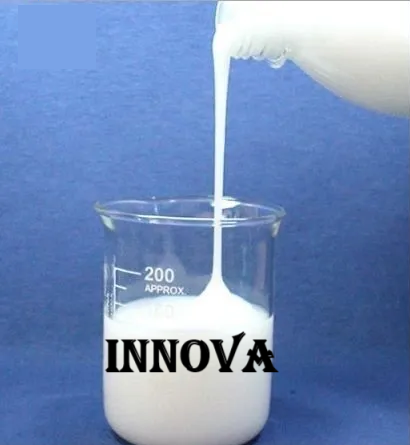
Innovacorp India Pvt Ltd manufactures, exports, and supplies defoamer for sugar mills and refineries in Nepal. The range covers silicone and non-silicone (ester-based) defoamers for foam control in juice, syrup, and molasses circuits. Technical support is available across Nepal from our New Delhi office.
Foam in a sugar mill is not a cosmetic problem. It is a process signal. Juice carries natural surfactants — proteins, saponins, pectins — that stabilise air bubbles. When the juice is agitated in the milling tandem or boiled in the evaporator, these surfactants form a stable foam layer. That foam takes up volume in the vessel, reduces heat transfer, and in severe cases causes foam-over — juice or syrup leaving the vessel with the vapour. Anyone who has worked a crushing season knows the pattern: foam builds up gradually through the day, and by evening the evaporator is running at reduced capacity. Defoamer is the chemical that breaks that cycle.
Foam has three stages: formation, stabilisation, and collapse. Defoamer works on the second and third stages. Antifoam (a related product) works on the first stage — it is added before foam forms, to prevent the foam from stabilising in the first place. In a sugar mill, the choice between defoamer and antifoam depends on where the foam is forming and how fast.
| Stage | What Happens | Product Response |
|---|---|---|
| Formation | Air is entrained in juice or syrup due to agitation. | Antifoam added upstream. |
| Stabilisation | Surfactants form a film around the bubbles. | Defoamer disrupts the film. |
| Collapse | Bubbles rupture and foam layer breaks down. | Defoamer accelerates this stage. |
The two main defoamer chemistries behave differently. The choice depends on the process temperature, the product contact, and the downstream requirements.
| Type | Strength | Typical Use |
|---|---|---|
| Silicone-based | High-temperature stability, fast knockdown | Evaporators, crystallisers, high-temperature circuits |
| Non-silicone (ester-based) | Easier downstream compatibility, non-silicone residue | Where silicone residue is a concern in the final product |
Defoamer is not a "more is better" chemical. Over-dosing can cause problems downstream — silicone carryover into the sugar, filtration issues, and in some cases a persistent haze. The dose is set carefully, and the dosing point matters as much as the dose. We set the dose after a plant trial on your process stream, and we advise on the dosing point and the addition method.
| Parameter | Typical Value |
|---|---|
| Appearance | Opaque to translucent liquid — confirm on TDS |
| Active content | Product-specific — confirm on TDS |
| pH (as supplied) | Product-specific — confirm on TDS |
| Density | Confirm on TDS |
| Temperature stability | Confirm on TDS |
| Shelf life | Confirm on TDS; store away from direct sunlight and heat |
Final specification is confirmed after a plant trial on your process stream.
Dosage depends on the foam severity and the process stage. A typical starting range is 50 to 500 ppm on the process stream, adjusted after a plant trial. The dose is set conservatively — over-dosing causes downstream problems, so we start low and increase only if needed.
We do not claim that defoamer will completely eliminate foam — it is a control measure, not an elimination measure. We also do not claim that every defoamer is suitable for food-contact applications without validation. Silicone and non-silicone grades have different downstream behaviour, and the choice is set after a plant trial. What the product does is knock down foam and help limit reformation within the operating window of your process.
We work with your process team on plant trials, dose confirmation, dosing point selection, and addition method. Onsite visits to Nepal mills can be arranged on request during the crushing season. For a quote or technical discussion, call +91-9312871070.
We manufacture, export and supply silicone and non-silicone defoamers for sugar mills and refineries in Nepal. The product is used for foam control in juice, syrup, and molasses circuits. Product selection is confirmed after a plant trial on your process stream.
Defoamer is typically added at the juice extraction stage, the evaporator, and the pan boiling stage, depending on where the foam is forming. The dosing point and dose are confirmed after a plant trial. Over-dosing can cause problems downstream, so the dose is set carefully.
Dosage depends on the foam severity and the process stage. A typical starting range is 50 to 500 ppm on the process stream, adjusted after a plant trial. Our technical team supports the trial and dose confirmation.
Yes. We manufacture, export and supply defoamer in packing of 5 L, 20 L, 35 L, and 200 L HDPE carboys and drums. For Nepal orders, call +91-9312871070 to discuss quantities and logistics.
For a quote or technical discussion, call +91-9312871070.
© 2026 Innovacorp India Pvt Ltd. All Rights Reserved. Managed & Developed by Innova Corporate India
 Chat with Us